
NIBIO
The team
- Inger Martinussen — Head of Research in Tromsø
- Hafeez Ur Rehman — Researcher in Apelsvoll, Leader of Communication and Dissemination in PheNo
- Krzysztof Kusnierek — Head of Research in Apelsvoll
NIBIO (Norwegian Institute of Bioeconomy Research) with locations all over Norway contribute to research in security and safety, sustainable resource management, innovation and value creation through research and knowledge production within food, forestry and other biobased industries.
About
NIBIO is one of Norway’s largest research institutes with approximately 750 employees and with locations all over Norway. At NIBIO, we specialize in the integration of advanced technologies with agriculture, particularly in the areas of precision farming, remote sensing, and soil-plant analysis and the understanding the plants responses to different environmental factors.
Within the PheNo infrastructure, we are contributing our expertise through the development and operation of field phenotyping platforms at key research stations such as Apelsvoll, Særheim, and Tromsø.
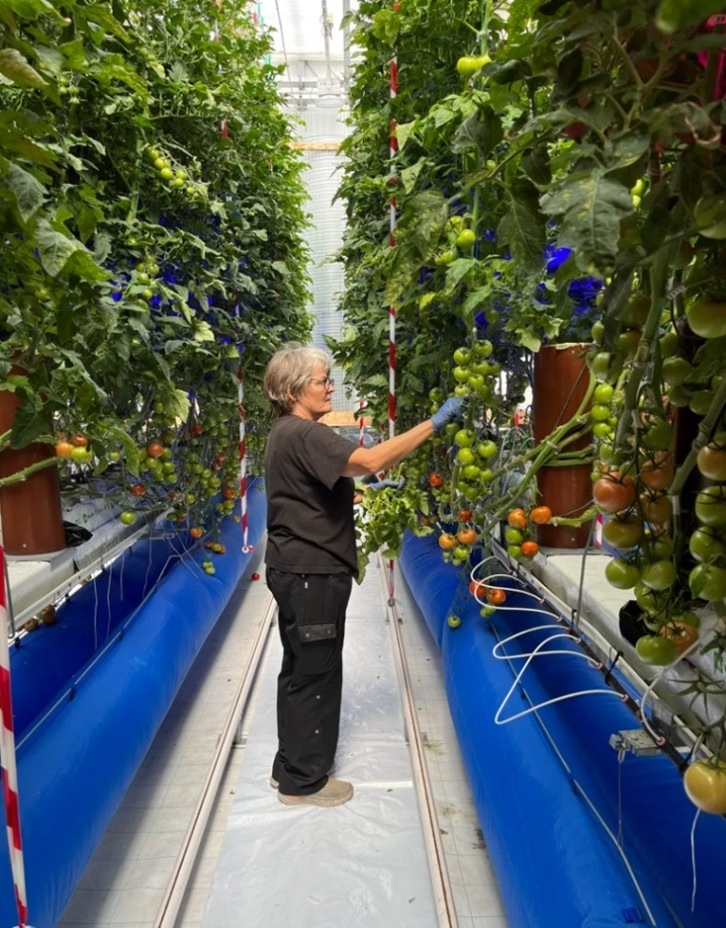
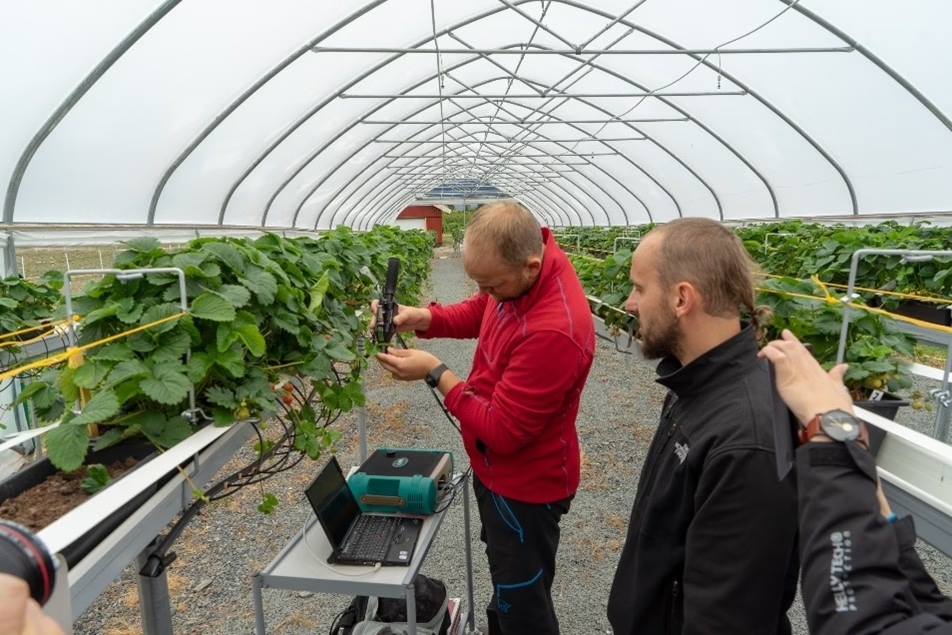
Our role involves the use of UAVs, environmental sensor networks, and controlled environment setups like polytunnels to monitor plant performance under real-world and experimental conditions. We will provide services such as high-resolution imaging, soil and plant diagnostics, and digital decision-support tools that support researchers and industry partners in studying crop traits, stress responses, and environmental interactions. This work strengthens Norway’s capacity in plant phenotyping and helps accelerate sustainable innovation in agriculture.
Services provided
- Field phenotyping facilities equipped with UAVs and digital tools for high-throughput phenotyping
- Environmental sensor networks for continuous monitoring of soil and atmospheric conditions.
- Controlled environments, including greenhouses and polytunnels for experimental phenotyping.
- Advanced data management and analysis capabilities, including deep learning and image processing tools.
Apelsvoll Research Station
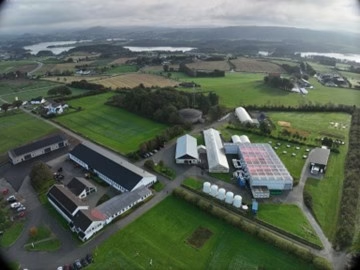
Apelsvoll station provides essential infrastructure for field experiments, including state-of-the-art laboratories and field trials. Apelsvoll Research Station lies to the west of lake Mjøsa in Østre Toten municipality. The station is located on gently sloping land at an elevation of 250 meters and has 80 hectares of humus-rich morainic loam soil. Of this, 50 hectares are suitable for field trials. The latter area is mostly flat, with a southerly aspect. Much of the area is systematically drained and the farm is supplied with irrigation water from two large irrigation facilities. The soil and climatic conditions are well-suited for the production of most of the field crops normally grown in Norway.

Særheim Research Station
Located in Klepp municipality, Særheim station supports agricultural research in mild, humid conditions ideal for fodder production. The research station is today part of Rogaland Agriculture Park, which comprises 11 organisations and companies connected with agriculture. Amongst these are Norway’s Agricultural Advisory Service NLR, the Winter Agricultural College, Klepp Accountancy Team and the College of Agriculture and Rural Development.
NIBIO Særheim has a research greenhouse covering 700 m2 with 8 departments each of 70-100 m2. There is also a phytotrone with 8 chambers, each of 9-12 m2. Both buildings have advanced climate regulation (temperature, light, CO2, humidity), and fertilizer supply can be regulated with a large number of nutrient combinations. The climate computer is amongst the most advanced available and both regulates and records climatic conditions in 24 departments. There are also several cols stores at Særheim, in which temperature can be controlled from -20 °C upwards. In 11 specially adapted freezer cabinets the temperature can be regulated and logged for research on responses to climate and stress. Construction of a new greenhouse of almost 1000 m2 will be completed early in 2018.
Outdoors, Særheim has just less than 40 ha of fully cultivated land. The soil type, characterised as a humus-rich silty sand developed from morainic material, is typical for the region and is suitable for many types of production. At lysimeter facility with 8 cells has been established on two soil types. In 2014 the environmental research was directed towards strengthening research into urban questions, and a facility for studying ‘green rooves’ was established with 10 research units. From these it is possible to measure water runoff with a time interval of five minutes. Weather data is collected from a weather station connected to the Meteorological Institute.
NIBIO Tromsø
NIBIO Tromsø farm is the world’s northernmost research station in soil and plant culture and is located on the west side of Tromsøya, just 2.5 km from the center of Tromsø. It is in many ways a green oasis in an otherwise urban area. The property is in total 43 hectares, of which 14 consists of cultivated land, 2,5 pasture and 17 forest. Work is being done on cultivated and uncultivated land, land use and resource mapping, climate impact and rural development. The unique geographical location close to the limits of cultivation in the north provides opportunities to test plant growth and plant physiological conditions at low temperatures and with light around the clock during the growing season. Development and testing of plant material that can withstand the climate in northern areas is one of the core tasks at the station. In this context, variety testing (commissioned by Graminor) and value testing/variety approval (commissioned by the Norwegian Food Safety Authority) are conducted.
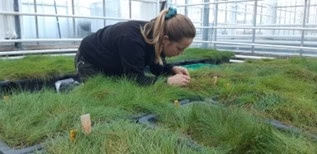
The climate laboratory is owned and operated in collaboration with UiT – The Arctic University of Norway and is one of three such facilities in the country. It allows for experiments under controlled light and temperature conditions and is of great importance for research on plant growth and climate adaptions. Adjacent to the climate laboratory, we have a chemical laboratory and a separate greenhouse.

Photo: Tor J. Johansen
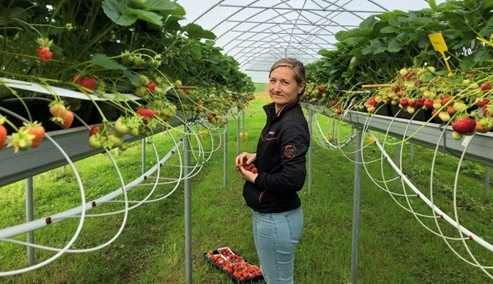
Cultivated land for field trials, a plastic tunnel for berry production and the climate laboratory with experimental greenhouses are the most important parts of the infrastructure for research at NIBIO Tromsø. The growing season is short with approx. 140 growth days and 612- day degrees. The average annual precipitation is 1031 mm. There is a meteorological monitoring station on the farm where data is posted continuously on the yr.no. In addition, frost depth (soil) is measured every week during the winter.
To be announced:
- Anything?