

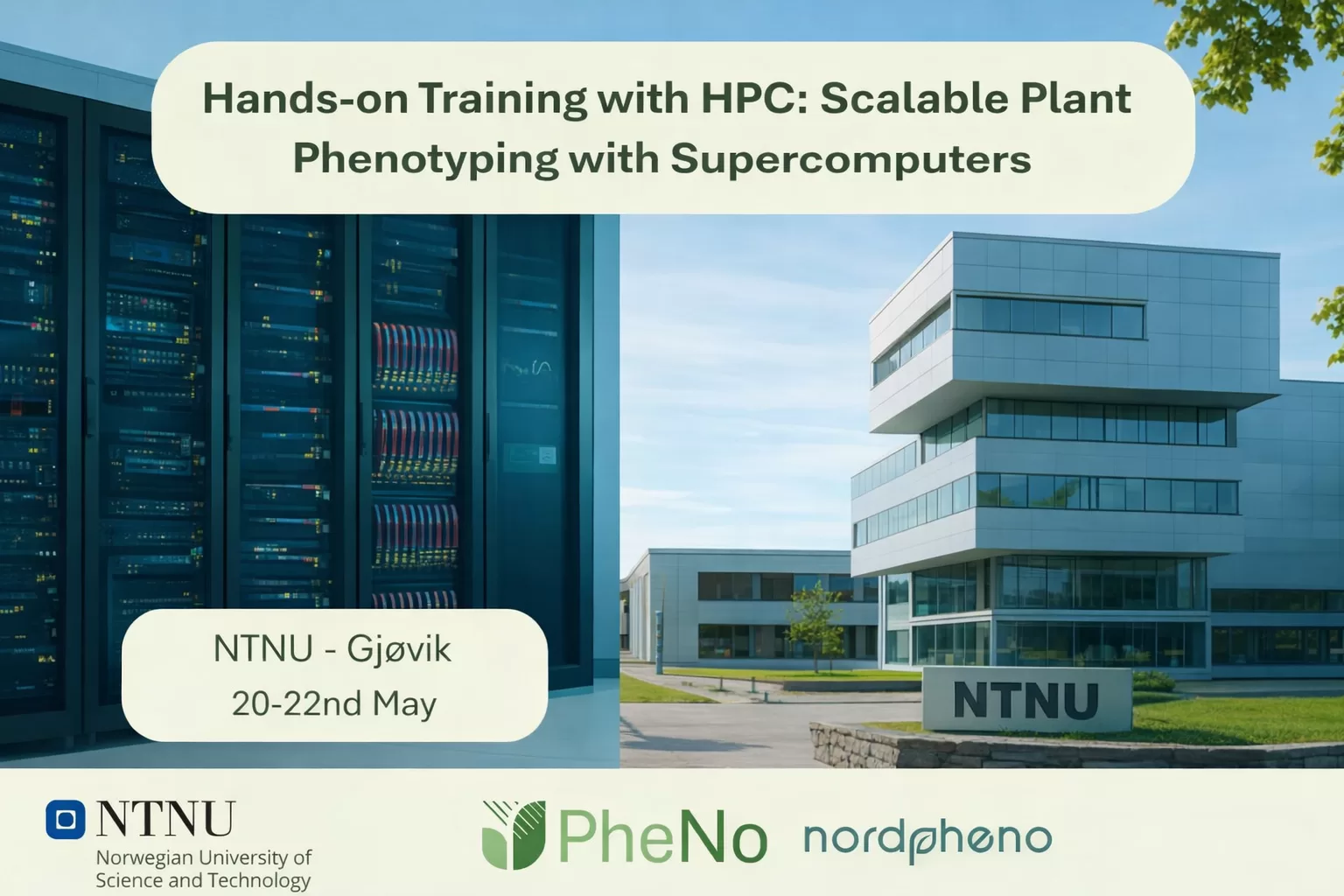
This hands-on hybrid workshop introduces researchers and practitioners to scalable AI workflows for plant phenotyping using High Performance Computing (HPC). Participants will gain practical experience in deploying, training, and optimizing AI models on Norway’s supercomputing system – Olivia.
Target Audience
- NordPheno consortium members
- Plant scientists & phenotyping researchers
- AI/ML researchers and practitioners
- Data-intensive researchers working with large datasets
- Nordic researchers (open globally, registration required, limited seats)
Register and talk to us
Contact: Vijeta Sharma or Sara Laranjeira
3-Day Workshop Plan in a nutshell
Venue: NTNU – Gjøvik, Norway
Online: (only talks, not the hands-on sessions)
Capacity: Hands-on limited to 30 participants, Registration is mandatory
Registration deadline : May 11
Register here
- Day 1: Foundations + Invited Talk
- Day 2: Hands-on core skills + Invited Talk
- Day 3: Scaling + real workflows + Invited Talk
By the end of this workshop, participants will be able to:
- Understand the role of HPC in AI workflows and explain why large-scale computing is essential for data-intensive applications such as plant phenotyping.
- Navigate and use HPC systems Olivia, including logging in, managing files, and working with software environments for AI tasks.
- Deploy and run AI models on HPC infrastructure, including performing inference and training using GPU resources.
- Submit, monitor, and manage batch jobs for large-scale AI training, and effectively handle outputs, logs, and errors.
- Scale AI workflows from single-GPU to multi-GPU settings, applying best practices for efficient model training and performance optimization.
Agenda:
Day 1 (20 May 2026) Time: 11:00 – 15:00
11:00 – 11:20 | Welcome & Workshop Overview (Faouzi Alaya Cheikh, NTNU, NO)
- Introduction of instructors & participants
- Workshop goals and expected outcomes
- Overview of NordPheno context
11:20 – 12:00 | Introduction to HPC for AI (Vijeta Sharma, NTNU, NO)
- What is HPC and why it matters
- Why AI needs HPC (compute, storage, scaling)
- Real-world examples in plant phenotyping
12:00 – 12:45 | Invited Talk 1 + Q&A
Why do we need GPUs and what makes them different from CPUs? – Jørn Dietze, Norwegian Research Infrastructure Services (NRIS), UiT, (NO)
12:45– 13:30 | Lunch Break
13:30 – 14:00 | AI Basics for Plant Phenotyping (Mohammed Moosa, NTNU, NO)
- Overview of deep learning (CNNs, vision models)
- Typical phenotyping workflows (image → trait extraction)
- Challenges: data size, compute, scalability
- AI PhenoTyping Toolbox demo
14:00 – 14:30 | HPC Ecosystem in Norway & Europe (Vijeta Sharma, NTNU, NO)
- Saga, IDUN, Olivia from Norway
- LUMI, Finland
- Other EuroHPC systems
- When to use HPC and which one?
14:30 – 15:15 | Hands-on 1: Getting Started on Olivia [in-person]
Jørn Deitze, Norwegian Research Infrastructure Services (NRIS), UiT (NO)
Interactive session
- Login and system overview
- File system & environment basics
- Software modules / containers
- Quick demo: running a simple job
Learning Outcome: Everyone successfully logs in and runs their first job
Day 2 (21 May 2026) Time: 10:00 – 16:00
10:00 – 10:15 | Recap & Day Plan
10:15 – 11:30 | Hands-on 2: Environment & Data Setup [in-person]
Jørn Deitze, Norwegian Research Infrastructure Services (NRIS), UiT (NO)
- Software-hardware compatibility
- Setting up Python/AI environment (Conda/containers)
- Data transfer strategies (local → HPC)
- Working with large datasets
11:30 – 11:45 | Coffee Break
11:45 – 12:15 | Invited Talk 2 + Q&A
HPC Performance Engineering Concepts and AI Python code Profiling – Buket Benek Gursoy, Computational Scientist, ICHEC, University of Galway (IE)
12:15 – 13:15 | Lunch Break
13:15 – 14:15 | Hands-on 3: AI Model Training [in-person]
Vijeta Sharma, NTNU (NO) /Jørn Deitze, NRIS, UiT(NO)
- Loading plant phenotyping dataset
- Running a pre-trained model
- Model inference on HPC
- Understanding GPU usage
- Training a simple deep learning model
- GPU vs CPU comparison
- Introduction to hyperparameter tuning
14:15 – 14:30 | Coffee Break
14:30 – 15:00 | Hands-on 4: Job Submission & Monitoring [in-person]
Jørn Deitze, Norwegian Research Infrastructure Services (NRIS), UiT (NO)
- Batch job submission (SLURM or similar)
- Monitoring jobs
- Handling output & error logs
- Debugging failed jobs
Learning Outcome: Participants can run and monitor training jobs independently
Day 3 (22 May 2026) Time: 10:00 – 15:00
Objective: Scaling, advanced model training, real use cases
10:00 – 10:15 | Invited Talk 3
HPC at Sigma2: Norway’s National Supercomputing Centre – Steinar Gundersen, Sigma2, Trondheim (NO)
10:15 – 10:30 | Recap & Advanced Topics Overview
10:30 – 11:30 |Hands-on 5: Scaling AI on HPC [in-person]
Vijeta Sharma, NTNU (NO)
- Single GPU vs Multi-GPU training
- Distributed training basics
- Performance considerations
11:30 – 11:45 | Coffee Break
11:45 – 12:15 | Invite talk 4 +Q&A
Acclerating Python for Development, and AI Training – Sasmita Mohapatra , Texas Advanced Computing Center (TACC), The University of Texas at Dallas (USA) + Q&A
12:15 – 13:15 | Lunch Break
13:15 – 14:15 | Hands-on 6: Interactive vs Batch Workflows [in-person]
Jørn Deitze, Norwegian Research Infrastructure Services (NRIS), UiT (NO)
- Interactive jobs for prototyping
- Batch jobs for large-scale training
- Best practices for HPC usage
14:00 – 14:15| Coffee Break
14:15 – 15:00| AI in Plant Phenotyping & Mini Project / Guided Exercise [in-person]
Case Study:
- Use case
- End-to-end workflow:
Data → preprocessing → training → results
- Discussion: participants’ datasets & challenges
- Participants run a complete pipeline: 1. Load dataset; 2. Train model and 3. Evaluate results
15:00 – 15:30 | Wrap-up & Feedback
- Key takeaways
- Resources for further learning
- Feedback